
And how a two-layer ESD box + EPE foam design delivers compliance without over-engineering your cost.
Category: ESD Packaging Engineering | Reading time: 8 min
The Billion-Dollar Problem Most Manufacturers Still Get Wrong
Every year, electrostatic discharge (ESD) causes an estimated $5 billion in losses across the global electronics industry. Damaged chips, degraded sensors, field-returned circuit boards — the cost is staggering and largely invisible, because most ESD damage is latent: the component passes inspection today but fails weeks or months later in the customer's hands.
Yet when it comes to choosing ESD-safe packaging, many procurement teams still confuse two fundamentally different categories: static dissipative and anti-static. The difference is not academic — it determines whether your packaging actually drains a static charge before it can harm your product, or merely slows it down.
Two Resistance Ranges, Two Completely Different Mechanisms
|
Property |
Static Dissipative (10⁴–10⁸ Ω) |
Anti-Static (10⁶–10⁹ Ω) |
|
How it works |
Actively conducts charge to ground in milliseconds |
Slows charge generation; dissipation takes seconds |
|
Standard |
ANSI/ESD S20.20 & EIA-541 |
IEC 61340-5-1 (general) |
|
Suitable contact |
Direct contact with bare ESD-sensitive devices (ICs, PCBAs, sensors) |
Outer packaging, non-contact scenarios |
|
Charge decay (5kV → 0) |
< 0.1 s typical |
0.5 – 2 s typical |
|
Risk if used wrong |
None — exceeds requirements |
Charge may persist long enough to arc and damage Class 0/1 devices |
KEY TAKEAWAY: A surface resistance of 10⁶–10⁹ Ω (anti-static) overlaps with the dissipative range only between 10⁶ and 10⁸ Ω. Below 10⁶, you are in the more conductive dissipative zone. Above 10⁸, you are in the slower anti-static zone. When a client specifies 10⁴–10⁸ Ω, they are demanding the full dissipative range — the packaging must be capable of rapid charge bleed-off, not merely passive charge suppression.
Why Your Client Specifies 10⁴–10⁸ and Not 10⁶–10⁹
If the packaging is only an outer shipping container that never touches the bare product, 10⁶–10⁹ Ω would suffice. But when the corrugated polypropylene box serves as a first-line work-in-process (WIP) tote — sitting on the SMT line, opened and closed repeatedly by operators, directly housing exposed PCBAs or sensor modules — the box itself becomes part of the ESD-protected area (EPA).
In that scenario:
· Charge must drain before an operator reaches in to pick up a board.
· The packaging must not tribocharge against gloves, conveyor belts, or other boxes during stacking.
· End-customer auditors (automotive OEMs, medical-device companies) will measure the box surface with a megohmmeter and reject anything outside the 10⁴–10⁸ window.
Specifying 10⁴–10⁸ Ω is not over-engineering — it is the minimum credible requirement for any container that enters the EPA.
The Two-Layer Protection Strategy: ESD Shell + Cushioning Core
A well-engineered ESD tote does not demand that every material inside it be static dissipative. That would be expensive and unnecessary. The smarter approach is a two-layer architecture:
Layer 1 — ESD Corrugated Polypropylene Box (the shield)
· Surface resistance 10⁴–10⁸ Ω across all surfaces: walls, lid, base.
· Forms a continuous static-dissipative enclosure — a Faraday-cage-like envelope that bleeds any charge to ground contact.
· Handles, latching lid, and corner reinforcements are integrated into the same ESD material — no insulative gaps.
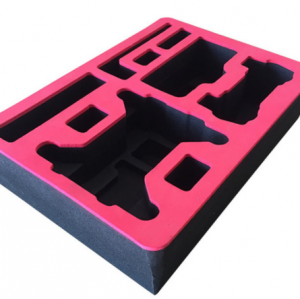
Layer 2 — White EPE Foam Inserts (the cushion)
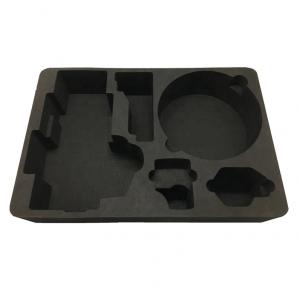
· Standard (non-ESD) expanded polyethylene foam: top/bottom pads, perimeter walls, and product-specific support strips.
· Provides mechanical shock absorption, vibration damping, and precise positioning of the product inside the ESD envelope.
· Does not need to be conductive or dissipative, because the outer box already establishes the ESD-safe environment.
COST IMPACT: ESD-grade EPE foam (carbon-loaded, black or pink) costs 40–60% more than standard white EPE. By confining the ESD function to the outer shell and using plain EPE inside, clients save significantly on per-unit packaging cost — without compromising ESD compliance. This is not a corner-cutting shortcut; it is recognized best practice per ESD TR 20.20 Annex B.
Inside the Box: Two Real-World Configurations
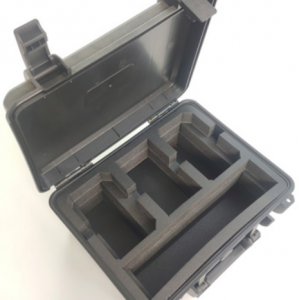
Configuration A — Multi-Layer Die-Cut Divider Tote
Internal dimensions: 445 × 345 × 230 mm. Three layers of 5 mm ESD corrugated dividers lock into the box body, each layer subdividing the space into individual cells. Every divider sheet is fixed to the base to prevent shifting.
What goes inside: Small-to-medium ESD-sensitive components — PCB assemblies, IC trays, sensor modules, automotive ECUs — arranged in grids across three tiers. The three-layer divider system maximizes packing density while ensuring zero part-to-part contact.
Why it matters: Without fixed dividers, components migrate during transit, collide, and generate triboelectric charge on their surfaces. Fixed, ESD-rated dividers eliminate both risks simultaneously.
Configuration B — Long-Profile Foam-Cradle Tote
Internal dimensions: 800 × 210 × 180 mm. Seven pieces of precision-cut white EPE foam create a fully lined cavity that cradles a single long-form product:
· 2 × full-coverage sheets (795 × 205 × 10 mm) — top and bottom cushion pads
· 2 × long side walls (730 × 140 × 25 mm) — lateral support along the full length
· 2 × end walls (210 × 140 × 25 mm) — axial retention at both ends
· 1 × narrow support strip (660 × 50 × 25 mm) — inserted into the product's longitudinal channel or groove to provide internal support and prevent deformation during transit
What goes inside: A single long, high-value assembly with a hollow channel or recessed groove — such as an LED aluminum-profile luminaire, a linear heat-sink module, a rail-transit electrical housing, or an industrial linear actuator. One unit per box, fully enveloped.
Why a support strip inside the product channel: Products with hollow profiles (e.g., extruded aluminum housings) are vulnerable to cross-sectional deformation under stacking or impact loads. The 660 × 50 × 25 mm foam strip fills the internal void, acting as a structural brace that absorbs shock from the inside out — a detail that demonstrates true application-level packaging engineering.
Gram Weight: The Specification Most Buyers Overlook
Corrugated polypropylene sheets are specified by thickness and gram weight (g/m²). Two sheets of identical 5 mm thickness can weigh 600 g/m² or 1,200 g/m² — and they will perform very differently:
|
Gram Weight |
Wall Rigidity |
Stack Load |
Best For |
|
600–750 g |
Light flex |
2–3 layers |
High-frequency line-side totes, light components |
|
800–950 g |
Firm |
4–5 layers |
Mid-weight assemblies, mixed WIP + shipping use |
|
1,000–1,200 g |
Rigid |
6+ layers |
Heavy modules, long-haul logistics, outdoor stacking |
Customizable gram weight means the buyer pays for exactly the structural performance they need — no more, no less. Over-specifying adds dead weight and cost; under-specifying leads to box deformation and product damage. The ability to dial in gram weight per project is a hallmark of a manufacturer that understands application engineering, not just sheet extrusion.
Choosing the Right ESD Packaging Partner
When evaluating ESD corrugated box suppliers, ask these questions:
1. Can they document the surface resistance range and test method? Look for per-batch test reports referencing ANSI/ESD STM 11.11 or IEC 61340-2-3.
2. Do they design the internal fitment — or just the box? Dividers, foam inserts, and support strips should be engineered together with the shell, not sourced separately.
3. Can they adjust gram weight per project? A one-size-fits-all supplier cannot optimize your cost-to-performance ratio.
4. Do they understand the two-layer strategy? If a supplier insists every internal component must be ESD-rated, they are either uninformed or upselling.
5. What is their lead time for new tooling and repeat orders? Electronics manufacturing moves fast; your packaging partner must keep pace.
CONTACT US
We engineer static-dissipative corrugated polypropylene totes with precision-fit internal solutions — from multi-layer dividers to foam-cradle long-profile designs. Tell us what you are packing, and we will design the protection around it.
Contact us for a free packaging assessment.